
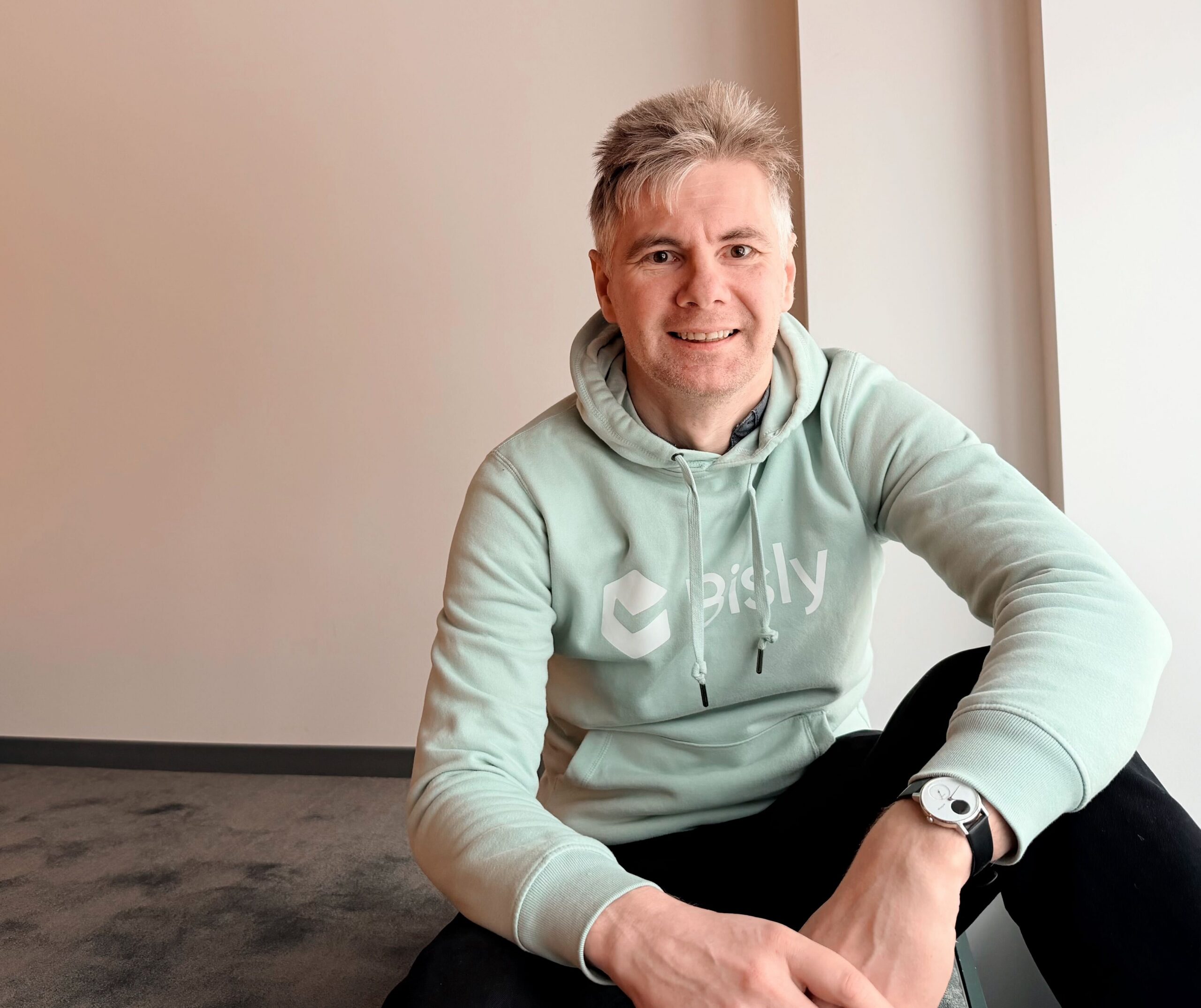
With experience from some of Estonia’s most iconic tech companies — Skype, Cleveron, Veriff — Priit has spent his career building systems that quietly survive explosive growth, global usage and constant change. The kind of infrastructure most people only notice when it breaks.
Now, he’s bringing that unicorn-scale mindset to Bisly as our Head of Infrastructure, taking ownership of the foundations that power thousands of real buildings across Europe — from cloud to devices to the physical world itself.
In this interview, Priit talks about scale, simplicity, and why infrastructure leadership is really about choosing the right problems to fix when everything is on fire (and something always is).
From scale to stability: building infrastructure that quietly powers smart buildings. Can you walk us through your professional journey and the experiences that shaped how you think about infrastructure at scale?
I’m one of the lucky ones that started my first job in IT – assisting and replacing my father as “IT guy” – or IT Generalist as they say nowadays. It started with solving problems – be it missing cabling and finding broken connections or installing and configuring software – customer needs something done and underlying IT infrastructure enables it. Often there’s a human in the loop to fix problems and keep things running. Later came Skype, Rocket Internet, Cleveron, Veriff etc. that taught me the effects of scale. Whether one’s actions influence few people or get magnified around the world. I’m Being humbled by the potential of current position and being thankful to the people and learnings that brought me here.
Infrastructure is often invisible when it works. What made you excited to take ownership of it at Bisly?
It’s the fun and the painful part of the IT infra that it’s often overlooked and treated as something that just works. Hard design decisions and maintenance work is often invisible to final consumer of the product. I somehow find my excitement in understanding and solving complex problems. At Bisly it’s easy to explain what I’m doing – I help buildings tick.
Bisly operates across cloud, devices, and real buildings. What kind of complexity excites you most about working in that setup?
Hardware is hard. One has to support devices released ten years ago. These constraints influence underlying complexity of the system. I want to nudge the system towards simplicity. Keeping in mind that the simpler version of the world can still be immensely complex when zoomed in.
How do you see infrastructure supporting Bisly’s growth as we expand into new markets, customers, and building types?
I see there’s a lot of work to do towards standardisation, support playbooks and systems self-healing. In order to do well and enable growth we have to stick with 1-2 hardware options that are supported across all the markets. They don’t have to be the cheapest but reliability and support must be top notch.
What’s one thing people outside of infrastructure usually underestimate about this role?
I think people underestimate how hard it’s finding the balance between mopping the floors and fixing the leaks – figuratively speaking. You must do both to be successful. You don’t have time to do both things perfectly. Therefore, healthy balance and compromise is essential. Moving parts tend to wear out and something somewhere is always broken. And the ones who scream loudest seem to have the biggest problem – which is often not true.
Keeping your focus while fixing the important things is often taken as granted.
Looking a few years ahead, what would make you proud of the infrastructure function you helped build at Bisly?
We had a running joke at Veriff – “triple, triple, double, double” – 36x growth in four cycles. If some of my decisions and processes survive this growth and then need refactoring – they’ve been good ones. If a design does not survive 10x growth – some more time at drawing table might have helped. If a design survives 100x growth and there seems to be no problem growing 100x more – it’s either genius or overengineered.
Before we wrapped up, we asked Priit a few quick questions — the kind that reveal how someone actually thinks when no system is on fire (yet):
- Best way to reset your brain? Stand up and walk around.
- Coffee or walking meeting? Whiteboard + yerba mate. Best of both worlds (with good ventilation).
- A workplace value worth protecting? Respect the culture. Respect others.
- A leadership lesson he keeps coming back to? If it works, it ain’t stupid. But always ask why it works.
- Early bird or night owl? Night owl. (Or 6AM, if the house is finally quiet.)
- Most underrated skill in infrastructure leadership? Perseverance. Starting change is easy. Finishing it is rare.
That last one says a lot.
As Bisly scales across new markets, building types, and millions of square meters, Priit’s mission is simple, even if the work isn’t: make the complex feel boring, stable, and invisible.
We are so happy to have you, Priit!