
As residential and multi-unit developments grow across Europe, the pressure on project timelines and installation costs has made building automation a key operational factor. Many projects still rely on legacy platforms such as KNX and Loxone, which were originally designed for individual homes and specialist installations. In practice, this results in longer commissioning time, higher labour cost and limited scalability for multi-unit residential buildings.
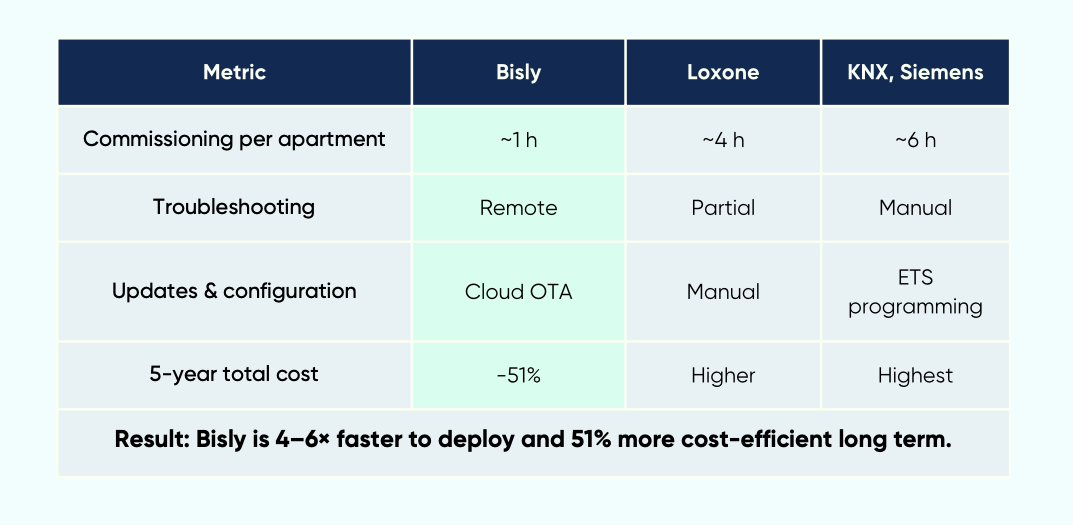
Our recent comparison measured the real commissioning hours and installation cost between Bisly and legacy systems in delivered residential projects. Across the evaluated cases, Bisly achieved 51% lower total cost and 4–6× faster commissioning, based on real installation data.
Commissioning time
The largest difference appeared in the time required to configure each apartment. KNX and Loxone rely on manual programming and project-specific logic, which results in longer commissioning periods. In the measured projects, a single KNX or Loxone unit required 4–6 hours to configure on site, while Bisly completed the same setup in approximately 1 hour using digital-twin assisted configuration and automatic device discovery. For projects of 100 or more units, this difference results in weeks or months of cumulative labour.
Installation and on-site work
Legacy automation typically requires device-by-device setup and multiple configuration steps performed physically on site. Bisly replaces these steps with cloud-based configuration and standardised logic across units. This reduces installation labour and limits site visits, which becomes increasingly valuable in larger buildings.
Scalability across multiple units
The comparison also shows that the commissioning efficiency increases as the project size grows. Since Bisly applies a repeatable configuration model, units and buildings can be deployed using the same approach. Legacy systems typically require additional engineering effort for each installation, which limits scalability in larger residential projects.
Why this matters for residential and multi-unit developments
Residential projects in the UK, Germany and Poland increasingly include:
- multi-unit housing
- Build-to-Rent
- mixed-use residential
- student housing
- larger refurbishment projects
These require predictable installation cost, shorter commissioning windows and the ability to deploy automation across many identical units. The comparison demonstrates that Bisly achieves this more efficiently than KNX and Loxone in the evaluated installations.
Based on real project data
This comparison is not theoretical and does not include future projections. All numbers come directly from delivered residential deployments and measured installation times.
Conclusion
For residential and multi-unit automation, Bisly delivered significantly lower installation cost and faster commissioning than KNX and Loxone in the measured projects. This resulted in approximately 51% total cost reduction and 4–6× shorter commissioning time, based on actual deployment data across European residential installations.
Download the full comparison
The full case study includes:
- commissioning time breakdown
- cost comparison
- on-site configuration differences
- scalability implications
- partner results and feedback